Estate Planning in an Increasingly Digital World



As estate planning becomes increasingly digital, questions about electronic signatures and the validity of document copies are becoming more common. But the rules governing wills and powers of attorney vary significantly by state—and even by document type. While many states have embraced electronic options for powers of attorney, wills often remain subject to more traditional execution requirements.
The chart below provides an at-a-glance comparison of the rules in Pennsylvania, New Jersey, New York, Florida, Kentucky, Delaware and Washington, D.C., including whether virtual copies may be treated as originals and whether documents may be signed electronically.
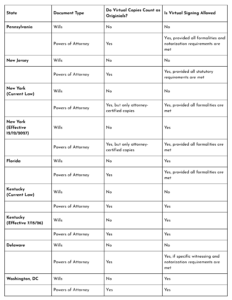
A Closer Look at Pennsylvania Powers of Attorney
The distinction between originals and copies warrants a closer look in Pennsylvania, particularly because financial and health care powers of attorney are governed by different statutory provisions.
Copies of financial powers of attorney, which are governed by Pennsylvania’s Power of Attorney Act, 20 Pa.C.S. § 5602, generally carry the same legal effect as the original document. The statute expressly provides for this treatment.
Health care powers of attorney, governed by 20 Pa.C.S. § 5454, are somewhat different. The statute does not expressly state that a copy has the same legal effect as the original. However, several provisions contemplate and recognize the use of copies. Section 5454(d), for example, provides that a health care power of attorney becomes operative when a copy is provided to the attending physician. Section 5462(d) also requires an attending physician or health care provider who receives a health care power of attorney to arrange for the document or a copy to be placed in the principal’s medical record. Taken together, these provisions indicate that copies of health care powers of attorney are intended to be operative and functional.
As laws governing electronic estate planning documents continue to evolve, understanding the requirements in your jurisdiction is important to ensuring that your documents are properly executed and recognized when they are needed.
If you have questions about wills, powers of attorney, or other estate planning documents, contact Whitney Patience O’Reilly, chair of our Trusts & Estates Group.