What’s New?
We hope that you are enjoying the summer! In this issue, you will learn practical tips to limit liability under prevailing wage and hour laws. You will also learn about the circumstances in which business owners can be held personally liable when they have a common ownership interest through a corporate entity, such as an LLC or LLP. In addition, this issue contains an analysis of the Department of Labor’s recent opinion letter related to employees’ use of FMLA leave and the ability to reduce work schedule indefinitely. Lastly, check out our Q&A with the firm’s newest partners!
Michael I. Schwartz, Co-Editor-in-Chief
Christopher W. Sexton, Co-Editor-in-Chief
New Faces
 Chair of the firm’s new Family Law Group, Carolyn N. Daly is a partner in our Newark, NJ office. She is a New Jersey Supreme Court Certified Matrimonial Law Attorney who prides herself on her pragmatic, no-nonsense approach to resolving family law matters in a manner that best serves her clients and their families. Family court judges regularly appoint Carolyn as a mediator, guardian ad litem, and parent coordinator. She is trained in collaborative divorce, divorce mediation, parent coordination, and arbitration, and has significant experience handling divorce litigation, domestic violence, custody and parenting time, alimony, child support, college contribution, enforcement of settlement agreements, equitable distribution, and division of complex assets such as restricted stock units, stock options, cryptocurrency, deferred compensation, and closely held businesses.
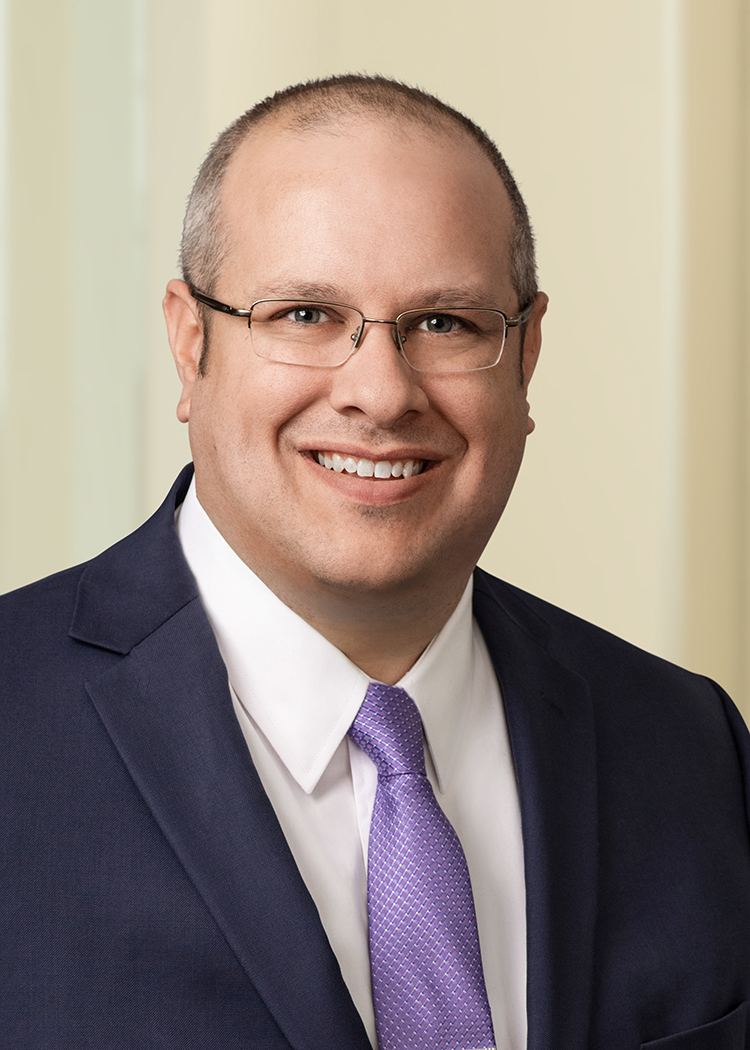 Sean P. Gaynor joined the Newark, NJ office as an associate in the Family Law Group. He devotes his practice to representing family law clients. Sean handles a wide variety of cases dealing with nearly every area of family law, including issues relating to custody and parenting time, alimony, child support, college contribution, removal/relocation, grandparents’ rights, emancipation, life insurance, and division of assets such as a business, real property, stock options, restricted stock units, retirement accounts and cryptocurrency.
 Paul V. Lucas, Jr. recently joined the firm’s New York office as a partner in the Construction Group. He focuses his practice on construction litigation and has more than 20 years of experience helping clients navigate complex construction claims from inception to trial. Paul regularly analyzes, prepares and litigates default and termination claims, delay claims, extra work disputes, and mechanic’s lien claims. He works with a variety of clients across the industry including contractors, subcontractors, developers, design professionals and owners handling construction matters and commercial litigation.
 Christopher A. Ouellette joined the Philadelphia office as an associate in the Business Transactions Group. He advises businesses and nonprofits on business formation, corporate governance and commercial transactions. Chris drafts and negotiates purchase and sale agreements for assets, stocks and real estate, as well as documents for mergers and acquisitions of all sizes. He also helps financial institutions, including banks and other lenders with all aspects of the commercial lending process.
Cohen Seglias Establishes Family Law Practice with Arrival of Partner Carolyn N. Daly and Associate Sean P. Gaynor
We are pleased to welcome Carolyn Daly as a partner, launching our Family Law Group. Carolyn is joined by associate Sean Gaynor in the firm’s Newark office, both were previously with Daly & Associates.
“We are excited to add a new practice to the services we provide our clients and complement our growing estate planning capabilities. Carolyn, who is highly regarded for her work in New Jersey, helps us achieve our goals of strategic growth,” said Cohen Seglias managing partner Steven Williams. “We welcome Carolyn and Sean and look forward to their contributions to growing our newly established family law practice.”
Six Attorney Promotions; Four New Department Chairs
We are excited to announce the promotions of Anthony Bottenfield, Jennifer Budd and Evan Rassman to the firm’s partnership. Anthony and Jen are located in the firm’s Philadelphia office, and Evan splits his time between the Wilmington and Philadelphia offices. In addition, Ashling Ehrhardt and Matthew Erlanger, both of the Philadelphia office, were promoted to senior counsel.
Lori Azzara was named a shareholder and joined the firm’s board of directors! Lori has made significant contributions to Cohen Seglias’ success and growth over the years.
We have also named four new department chairs, including Roy Cohen for Construction, Ashling Ehrhardt for Title IX, Jonathan Landesman for Labor & Employment, and Whitney O’Reilly for Wealth Preservation.
New Leadership Roles for George E. Pallas, Edward Seglias, Steven M. Williams and Evan A. Blaker
We are pleased to announce new leadership roles at the firm. Steve Williams is our new managing partner, and Evan Blaker is the firm’s new administrative partner; each will serve three-year terms. As managing partner, Steve is responsible for the day-to-day operations of the firm, working to improve operational efficiency and effectiveness. In his new role, Evan partners with Steve to develop and execute firm policies while assisting on issues involving legal operations.
In addition, Ed Seglias and George Pallas have been named co-CEOs of the firm, which went into effect last year. As co-CEOs, George and Ed lead the firm’s strategic direction and explore growth opportunities through bringing on lateral hires, adding practice areas and expanding to new geographic markets.
The National Law Journal Construction Trailblazers 2022: Edward Seglias
Cohen Seglias is pleased to announce that partner Edward Seglias is among The National Law Journal‘s 2022 Construction Trailblazers. The Trailblazers list celebrates lawyers, chosen from hundreds of nominations, who have made significant marks on the practice, policy and technological advancements in their practice areas.
Cohen Seglias Named a Pennsylvania Regional Powerhouse by Law360
Cohen Seglias has been selected as one of Law360’s 2022 Regional Powerhouses for Pennsylvania. Regional powerhouses are lauded for their handling of notable deals and litigation and for making a lasting impact on the law at the state and local levels.
The firm is noted for its strengths in construction and litigation and its growing bench of attorneys in a range of practice areas. Co-CEOs Ed Seglias and George Pallas spoke to the publication about the firm’s founding, growth and notable successes.
Cohen Seglias Recognized by U.S. News – Best Lawyers® on the 2023 “Best Law Firms List”
Our firm has been named to the 2023 U.S. News – Best Lawyers® “Best Law Firms” list nationally for construction and regionally in Philadelphia, Pittsburgh, Harrisburg and New Jersey for various practices. The firm is listed in the following areas:
- Litigation – Construction: National Tier 1, Metropolitan Tier 1 Philadelphia and Pittsburgh, Metropolitan Tier 3 New Jersey
- Construction Law: National Tier 2, Metropolitan Tier 1 Philadelphia
- Commercial Litigation: Metropolitan Tier 1 Harrisburg
- Employment Law – Management: Metropolitan Tier 2 Philadelphia
- Labor Law – Management: Metropolitan Tier 2 Philadelphia
- Litigation – Labor & Employment: Metropolitan Tier 3 Philadelphia (new this year)
- Insurance Law: Metropolitan Tier 3 Philadelphia
Firms included in the 2023 “Best Law Firms” list are recognized for professional excellence with persistently impressive ratings from clients and peers. Achieving a tiered ranking signals a unique combination of a quality law practice and a breadth of legal acumen.
Attorneys Named to 2023 Best Lawyers® List
Twelve Cohen Seglias attorneys are listed in the 2023 edition of The Best Lawyers in America©. Lawyers are selected based on an exhaustive peer-review process. In addition, a number of associates are included in Best Lawyers: Ones to Watch in America™, which recognizes extraordinary lawyers who have been in private practice for fewer than 10 years.
Attorneys Recognized as 2023 Best Lawyers
Lori Wisniewski Azzara, Litigation – Construction, Construction Law
Jonathan A. Cass, Insurance Law
Roy S. Cohen, Litigation – Construction
Jason A. Copley, Construction Law, Litigation – Construction
Shawn R. Farrell, Litigation – Construction
Marc Furman, Employment Law – Management, Labor Law – Management, Litigation – Labor and Employment
John A. Greenhall, Construction Law
Michael F. McKenna, Litigation – Construction
George E. Pallas, Construction Law, Litigation – Construction
Edward Seglias, Construction Law, Litigation – Construction
Lisa M. Wampler, Litigation – Construction
Steven M. Williams, Commercial Litigation
Attorneys Recognized as 2023 Best Lawyers: Ones to Watch
Kathleen M. Morley, Litigation – Construction, Construction Law
Jennifer R. Budd, Litigation – Construction, Construction Law
Tiffany R. Marini, Construction Law (new this year)
Gary J. Repke, Construction Law, Litigation – Construction (new this year)
Meghan L. Rice, Medical Malpractice Law – Defendants, Personal Injury Litigation – Defendants (new this year)
Kelsey E. Riehle, Litigation – Construction, Construction Law
George Pallas Named Best Lawyers® “Lawyer of the Year” for Construction
Managing partner George Pallas was selected as Best Lawyers® 2023 “Lawyer of the Year” for Litigation – Construction and Construction Law in Philadelphia. This recognition is awarded to individual attorneys with the highest overall feedback from their peers. Only one lawyer is recognized as such for each specific practice area and geographic region. George was a “Lawyer of the Year” for Litigation – Construction in 2019 as well.
PA Business Owners Beware—Mortimer v. McCool Creates New Exposure for Sister Companies in Piercing-the-Corporate-Veil Claims

Clients often worry if they can be held personally liable for a company in which they have an ownership interest. This is often followed by the question of whether one of their companies can be responsible for the obligation of another. In Pennsylvania, the answer to both questions is “yes,” but fortunately, it is not easy to do.
Piercing the Corporate Veil
Holding an individual responsible for the debts or liabilities of their company requires the corporate veil to be pierced. “Piercing-the-Corporate-Veil” is an exception to the general rule that when individuals form a corporation, a limited liability partnership (LLP), or a limited liability company (LLC), those individuals are not personally “on the hook” for the company’s debts or judgments. By way of example, a plaintiff who obtains a judgment against a corporation, an LLP, or an LLC that has insufficient funds or assets to satisfy the judgment may seek to collect from a corporation’s shareholders, LLP’s partners, or LLC’s members. However, courts strictly reserve this remedy for specific circumstances, including when a company is insufficiently funded (e.g., undercapitalized) and, most notably, when the entity’s interests are inseparable or comingled with its owners’ interests.
Piercing the Veil and the Mortimer Decision
When a company faces a lawsuit, owners, LLP partners, and LLC members are typically shielded from liability by a “corporate veil.” In Pennsylvania, courts tend to hesitate before “piercing the corporate veil” and finding owners and even their sister companies liable. However, in the summer of 2021, in the case of Mortimer v. McCool, the Pennsylvania Supreme Court considered and approved a new veil-piercing approach called “enterprise theory.” This theory states that when two or more “sister companies” operate as one, a successful plaintiff can seek to satisfy a judgment against a related “sister entity.” In Mortimer, the procedural posture was unique as the plaintiff had already obtained judgments against one insolvent entity and, through the appeal, sought to pierce the veil and collect on its judgments from a related and solvent “sister entity.”
In Mortimer, the court examined Pennsylvania case law regarding “piercing” and affirmed that there exists a “strong presumption in Pennsylvania against piercing the corporate veil” and “that the fundamental concern for its use only in cases of great injustice and inequity must remain the lodestar of piercing jurisprudence.” Put differently, the Mortimer Court restated that piercing the veil normally and under the enterprise liability theory is an exception to the rule and can only be entertained in limited circumstances. Essentially, a court will only consider holding an individual personally liable for the debts of a company when the individual abuses the privilege of having limited liability protection, such as routinely paying personal expenses through the company and purchasing personal property with company funds. And under the enterprise theory, a sister company will only be liable for the debts of another when there are common owners or there is an “administrative nexus” above the two entities. Otherwise, applying this theory would be unfair given the lack of connection between the two entities. On the other hand, the Mortimer Court also recognized that when the involved parties disregarded the corporate form, just like for general veil piercing, equity requires courts to disregard the typical protection for corporations, LLPs, and LLCs, and permit the collection from a related and solvent entity.
The court also looked to ten other states that usually limit the remedy to “truly egregious misconduct” and support applying the remedy when an owner abused the corporate form sufficiently enough that piercing through the form is a continuation of the owner’s prior actions that were tantamount to a pierce. Lastly, the Mortimer court considered the factors articulated by the Pennsylvania Supreme Court in Lumax Industries, Inc. v. Aultman (the Lumax factors), which are “undercapitalization, failure to adhere to corporate formalities, substantial intermingling of corporate and personal affairs[,] and use of the corporate form to perpetrate a fraud.”
Takeaways from Post-Mortimer Decisions: Has Anything Changed, and How Are Pennsylvania Businesses Affected?
A key takeaway from the Mortimer decision is that the liability of a sister company under the “enterprise theory” is essentially triangular. That is, liability flows from the debtor company up to the common owner and then from the common owner down to the “sister entity.” Put differently, a party must first get over the typically difficult hurdle of piercing the veil to reach the common owner and then reverse-pierce to reach the solvent “sister entity” and collect on the judgment. This is not an easy standard to meet, as made abundantly clear in Mortimer when the court recognized the existence of the remedy yet denied it to the plaintiff because one of the owners of the liable company did not have an ownership interest in the sister company. Therefore, while the Mortimer decision recognized the existence of the enterprise theory in Pennsylvania as a new way to pierce the veil, the Lumax factors must still be satisfied, and, therefore, the threshold requirements for veil-piercing remain quite high.
Although one may now seek to impose liability on a solvent “sister entity,” any plaintiff seeking recovery on this theory faces a number of difficult hurdles. These include procedural, pleading, and threshold requirements before they can succeed. Under Lumax and its progeny, Pennsylvania courts require plaintiffs to plead the required facts properly before the court will consider allowing the case to proceed under any piercing theory. Thus, if and when a plaintiff is aware of facts supporting such a theory, amending the pleading is vital. Also, plaintiffs seeking to pierce the veil must first succeed in their underlying claims. Only then can a plaintiff attempt to reach a sister company, and to do so, the Lumax factors must first be satisfied.
However, this finality requirement will work in a plaintiff’s favor when a defendant moves to dismiss claims under this theory. For example, in Seven Springs Mountain Resort, Inc. on behalf of Sikirica v. Hess, the court was unwilling to dismiss a veil-piercing claim under the “enterprise theory” because the evidentiary record was not developed and the court permitted the plaintiff to continue pressing this theory of recovery. Thus, while Mortimer allows for Pennsylvania claimants to “pierce the corporate veil” in a novel way, based on the two years since Mortimer, it appears that this avenue for recovery remains quite narrow and will continue to be difficult to successfully employ. Nevertheless, business owners, shareholders, and members alike – and especially those who own multiple entities – should respect the boundaries between those entities to avoid potential exposure under a “veil piercing” theory. If you have questions or concerns about these issues, please reach out to us so we can further guide you through these thorny issues.
Employees Can Now Use FMLA Leave to Reduce Their Schedules Indefinitely

On February 9, 2023, the U.S. Department of Labor (DOL) issued an opinion letter stating that employees may use the Family and Medical Leave Act (FMLA) to reduce their work hours indefinitely. The DOL issued its letter in response to an employer asking whether an employee with a chronic health condition can use the FMLA to limit their workday to eight hours when they normally work more than that in a day. The DOL’s answer was “yes,” an employee may use FMLA for an indefinite period of time as long as they have not exhausted their 12-week entitlement and continue to have a qualifying reason for leave.
Background on FMLA and “Reduced Schedule Leave”
To be eligible for leave under the FMLA, an employee must have worked for a covered employer for at least 12 months, must have worked at least 1,250 hours during the 12 months before the first day of the requested leave, and must work at a location where the company employs 50 or more employees within 75 miles. A qualifying reason under the FMLA is defined as the birth or placement of a child with the employee, caring for a child, spouse or parent who has a serious health condition, or the employee’s own “serious health condition.”
Eligible employees have the right to take up to 12 workweeks of FMLA leave within 12 months. However, the 12-week entitlement does not have to be used all at once. Instead, employees may use FMLA leave in increments of time as small as a company’s payroll system can track. Thus, employees have used FMLA time to limit their days and/or hours of work to create a “reduced leave schedule.” The DOL’s recent opinion letter simply clarified that FMLA can be used for an indefinite period of time to create a reduced leave schedule. The DOL also provided guidance on determining the number of FMLA hours an employee is entitled to take for reduced schedule leave and how an employee’s use of reduced schedule leave also impacts their rights under the Americans with Disabilities Act (ADA).
When Is an Employee Entitled to Reduced Schedule Leave Indefinitely?
The question on many employers’ minds is, probably, “How can an employee be entitled to shortened hours indefinitely when FMLA provides a 12-week entitlement per year?” In its letter, the DOL explained that an employee may continue to use FMLA leave until the employee has exhausted their 12-week entitlement to leave. Thus, if the employee never exhausts their FMLA leave, they may work the reduced schedule indefinitely. Or, put another way, “[i]f the employee never uses as much as 12 workweeks of FMLA leave in a 12-month period, the employee would never exhaust his or her statutory entitlement to take FMLA leave.”
How Employers Should Calculate the Hours an Employee Is Entitled To
It is imperative for employers to know how to properly calculate how many hours of FMLA an employee can take off when implementing a reduced schedule leave. As noted above, an employee is entitled to 12 workweeks of leave per year under FMLA. In its letter, the DOL explained to properly convert 12 workweeks into hours, an employer must evaluate how many hours a particular employee is typically required to work in a given workweek. Thus, if an employee is regularly scheduled to work 40 hours per week, they are entitled to 480 hours of FMLA per 12-month period. Alternatively, an employee who ordinarily works 50 hours per week would be entitled to 600 hours of FMLA leave in a 12-month period.
The Interplay Between FMLA Reduced Schedule Leave and a Request for Reduced Hours as a Reasonable Accommodation
In its February opinion letter, the DOL addressed the issue of whether a request for reduced hours under the FMLA might be “better suited” as ADA accommodations. The DOL cautioned that an individual who receives ADA accommodations is not precluded from also taking leave under the FMLA. Rather, the requirements and protections of the FMLA are separate and distinct from those of the ADA, and an employee may be entitled to invoke the protections of both laws simultaneously. Understanding this distinction is crucial because, just as an employer could be liable for interfering with an employee’s attempt to exercise an FMLA right, they could also be exposed to liability for interfering with an employee’s attempt to exercise their rights under the ADA.
Under the ADA, a qualified employee with a disability is entitled to “reasonable accommodations” that enable them to perform the essential functions of their job. Federal courts and the EEOC have long held that a reasonable accommodation may include a leave of absence or other time off from work, including a reduced leave schedule. Thus, even if an employee is not eligible for leave under the FMLA, or even if your company is not large enough to be covered by the FMLA, an employee may be entitled to a reduced leave schedule as a form of accommodation under the ADA. And as the DOL’s opinion letter makes clear, a reduced leave accommodation under the ADA may be available on an indefinite basis, including when an employee has exhausted their 12-week FMLA entitlement.
Reduced leave schedules and the interplay between the FMLA and ADA are highly complex and fraught with risk. If you have any questions about managing attendance and employees with medical conditions, please do not hesitate to contact the Cohen Seglias attorney with whom you ordinarily consult.
Don’t Get Exposed: Limiting Your Liability Under Prevailing Wage and Hour Laws
The construction industry has faced a skilled labor shortage over the past several years. One study found that the number of workers ages 25-54 dropped 8% over the last decade. At the beginning of 2022, one predictive model estimated that the industry would need more than 650,000 additional workers to meet demand. As a result of this labor crunch, many business owners have been forced to subcontract portions of their work to remain competitive in a tough industry with aggressive bidding and strict project deadlines. Subcontracting presents its own challenges for many construction businesses, which may find themselves having to work with unfamiliar and unproven companies. One significant challenge is that a construction company could face potential liability if a labor subcontractor (any of its lower-tier subcontractors down the chain) fails to comply with all applicable federal and state wage payment laws. For instance, a contractor might be surprised to learn that it could be legally responsible for a subcontractor not paying its employees.
Such potential liability arises from the Fair Labor Standards Act (FLSA), a federal law that applies nationally. For construction projects, courts have developed a multifactor balancing test to determine a contractor’s liability, which turns on whether there is an employment relationship between the contractor and the subcontractor’s employees. Courts may find that a relationship is formed regardless of whether or not they are the contractor’s formal employees, depending on how much control a construction company exercises over any laborers working under it. Based on the relevant facts of this test, these business owners could be on the hook for unpaid minimum wages, overtime pay, liquidated or treble damages, attorneys’ fees, and court costs. Thus, it is crucial for contractors to limit their liability exposure by ensuring that their downstream subcontractors are paying all of their employees working on the contractor’s project.
Determining Legal Responsibility
Courts consider the economic realities of a worker’s relationship to the putative employer in determining if a worker is an employee covered by the FLSA rather than an uncovered independent contractor. If a worker is jointly employed, courts usually apply a version of the economic realities test to assess if the worker is economically dependent on the putative employer or is in the business for his/herself as a matter of economic reality. To determine if a jointly employed worker constitutes an employee or independent contractor, the United States Court of Appeals for the Fourth Circuit developed a six-factor test that considers:
- The degree of control that the putative employer has over the manner in which the work is performed;
- The worker’s opportunities for profit or loss dependent on their managerial skill;
- The worker’s investment in equipment or material or their employment of other workers;
- The degree of skill required for the work;
- The permanence of the working relationship; and
- The degree to which the services rendered are an integral part of the putative employer’s business.
Federal courts in the Fourth Circuit (which include Maryland, Virginia, North Carolina and South Carolina) pay particular attention to the degree of control, the permanence of the working relationship, and the degree to which the worker’s services are an integral part of the putative employer’s business. Critically, because no single factor is dispositive and courts are directed to look at the totality of the circumstances, determining liability requires consideration of a wide range of factual circumstances. For a contractor facing liability, they would likely be forced to face the protracted and expensive discovery process in litigation.
Additionally, states have their own wage and hour laws that may provide equivalent or greater protection to employees than under the FLSA. For example, state courts in New York, New Jersey and Maryland follow their own versions of the economic realities test.
A Hypothetical Under the FLSA
Let’s take a fictional scenario to illustrate a door framing contractor’s hypothetical exposure under the FLSA and the Maryland Wage and Hour Law (MWHL). The contractor, Stanford Glass and Mirrors, Inc. (SGM), was hired by the general contractor, Maria Holmes Contractors (Holmes), to supply and install metal doors and frames in connection with the Big City Expansion project in Maryland. SGM engaged Bradshaw Windows and Doors, LLC (BWD) to supply labor for the work, but the two companies did not execute a formal contract to memorialize their agreement. BWD is owned by Elisa Gonzalez, who is also the company’s president. After a few bi-weekly paychecks bounced, some of the individual workers (the plaintiffs) brought legal action against Holmes, SGM, BWD, and Gonzalez in her individual capacity. The plaintiffs alleged that they were not paid minimum and overtime wages as required by the FLSA and the MWHL. Thus, all contractors upstream from BWD and Gonzalez faced potential liability under those statutes.
SGM, the door frame contractor, will be liable if the plaintiffs were “employees” on the project rather than “independent contractors” under the economic realities test. Additionally, SGM would have to be considered a “joint employer” with BWD. This is governed by yet another multifactor test that examines if a purported joint employer shares or codetermines the essential terms and conditions of a worker’s employment. Among other factors, the court would assess if the putative joint employers jointly determine, share, or allocate the power to direct, control, or supervise the worker, whether by direct or indirect means. Another factor is whether the work is performed on premises owned or controlled by one or more of the putative joint employers. While many contractors in SGM’s situation may reject the very notion that they could be considered a joint employer of a labor subcontractor’s employees, courts have held contractors in a similar scenario liable under these two multifactor tests.
Ways to Limit Exposure Under the FLSA
One of the best ways for a contractor to limit liability is to consider whether the risks of subcontracting out work are worth it. Given current market labor conditions, however, this may not be feasible. If a contractor must look to subcontract its labor work, it can limit its liability exposure under the FSLA by including specific clauses in formal agreements with the subcontractor. For instance, in its agreement with any subcontractor, a business owner/contractor could require the subcontractor to comply with the relevant wage laws, agree to identical indemnity language, provide all payroll records and additional information, and permit the contractor to review all of the subcontractor’s books and records in the event of a suspected violation of law. It also may be prudent to ensure that the subcontractor has an ongoing duty to supplement any relevant disclosure(s). Further, clauses could guarantee that failure to provide information in the format required by the contractor constitutes a reason for withholding payment to a subcontractor. Importantly, an owner/contractor could also guarantee that similar terms are implemented in a subcontractor’s agreement with any of its respective sub-subcontractors.
Conclusion
Federal and state wage and hour laws support the notion that a construction owner/general contractor may be jointly liable for its subcontractors’ or sub-subcontractors’ failure to pay the minimum wage or other benefits to their workers. The extent of their liability will be determined by the relevant jurisdiction’s legal test. Construction entities can and should limit their liability by consulting with legal counsel on how to limit liability, as well as including certain clauses in their contracts with their subcontractors.
Q&A with Cohen Seglias’ Newest Partners
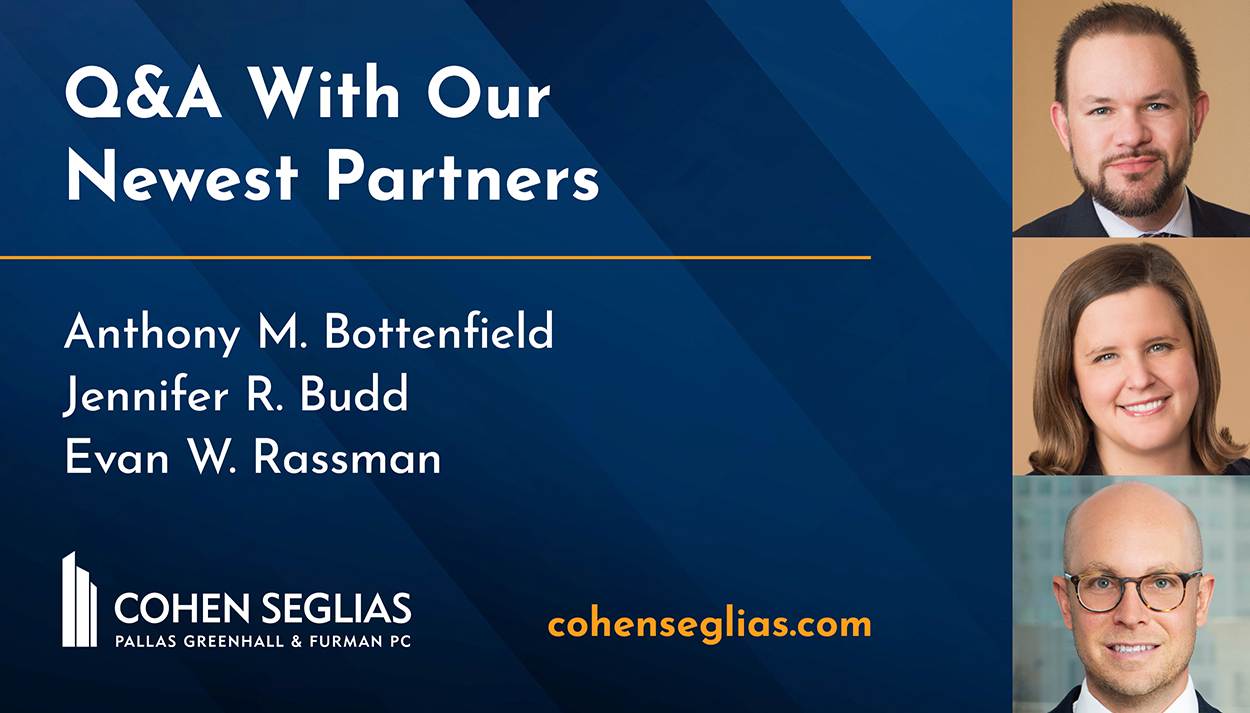
Anthony Bottenfield, Jennifer Budd and Evan Rassman were promoted to the firm’s partnership at the beginning of the year. Our newsletter team sat down with them to discuss their practices.
Q: Tell us a little about your practice and the services you provide to your clients.
Anthony: At Cohen Seglias, I represent a wide cross-section of clients connected to the construction industry. From a developer setting sights on a project to an excavation contractor breaking ground to a roofer topping off the structure, I provide guidance. I assist those clients with contract drafting and negotiations, as well as counseling before, during, and after construction through claims, mediation, arbitration, or trial.
Jen: As a member of the Construction Group, I represent contractors, subcontractors, owners and suppliers in disputes that arising from construction projects. I advise clients during difficult projects and in mediation, but I also represent clients during arbitration or litigation if that is necessary to resolve a dispute.
Evan: I primarily represent real estate developers and investors in all aspects of commercial real estate. A significant portion of my practice involves negotiating purchase and sale agreements, loan documents, and commercial leases.
Q: How did you get started in your career, and what drew you to Cohen Seglias?
Anthony: I joined Cohen Seglias as my first job out of law school and have been here ever since. I was drawn to the firm by its people. I knew little about the practice of law or being a lawyer as a new attorney. I received a strong welcome from those at the Cohen Seglias and that is a major reason for still practicing with them today.
Jen: I was a summer associate at Cohen Seglias in 2009. I then went to the New Jersey Attorney General’s Office where I represented the New Jersey Department of Transportation. I genuinely enjoyed learning from the attorneys at Cohen Seglias during my time as a summer associate and jumped at the chance to return.
Evan: I was always interested in real estate while growing up in the construction world. This led me to law school and a focus on commercial real estate. My draw to Cohen Seglias was multifaceted, but the platform really caters to the needs of my clients because it provides a ‘one-stop shop’ where they can seek counsel on a wide array of real estate services.
Q: What do you enjoy most about your practice?
Anthony: Every construction project is tangible and a little different from the next one. I enjoy helping clients navigate that process while learning about how the community around me is shaped.
Jen: Building on my time representing NJDOT, I created a specialty in disputes that arise in heavy highway, infrastructure and transportation projects. I really enjoy learning from my clients about their projects and the actual construction process. I also appreciate the opportunity to help clients navigate challenging projects and prevent elongated disputes.
Evan: Becoming a part of each project. I try to mentally partner with my clients on their deals and become very invested in the same. This makes the project much more personable and keeps the “work” interesting.
Q: What made you stay and grow here? What do you like about the firm?
Anthony: I joined Cohen Seglias because of its people and have stayed for the same reason. In addition, I was given the space and encouragement to grow inside and outside of the firm.
Jen: My relationships with my fellow attorneys, paralegals and professional staff make Cohen Seglias an enjoyable place to practice law. Further, with the support the firm provides, I am able to provide better representation for my clients.
Evan: This firm has allowed me to build my own practice and supported my efforts in doing the same. I get all the support I can ask for. Additionally, the resources around the firm are tremendous—from the business transactions group to the construction contracting team to the wills and estates practice.